
kusp: KIM Utility for Serving Potentials

Project description
KUSP: KIM Utility for Serving Potentials


This utility package provides an easy and quick way to deploy any potential, ML or otherwise to the KIM API. It is designed to be used as a quick prototyping and benchmarking tool against OpenKIM tests and verification checks. This ensures that any valid ML model is on equal footing with OpenKIM supported interatomic potentials, and can directly guide uses in improving their models or datasets etc.
Please note that KUSP is supplementary tool for model validation and development, and for high performance production runs, you are advised to use the KIM model drivers.
Difference between KUSP and TorchML model driver
KUSP used Python interpreter to run any ML model in its native environment, and then converts the output to KIM API compatible format. KIM API communicates with the model using the KUSP Python server, which uses sockets to communicate.
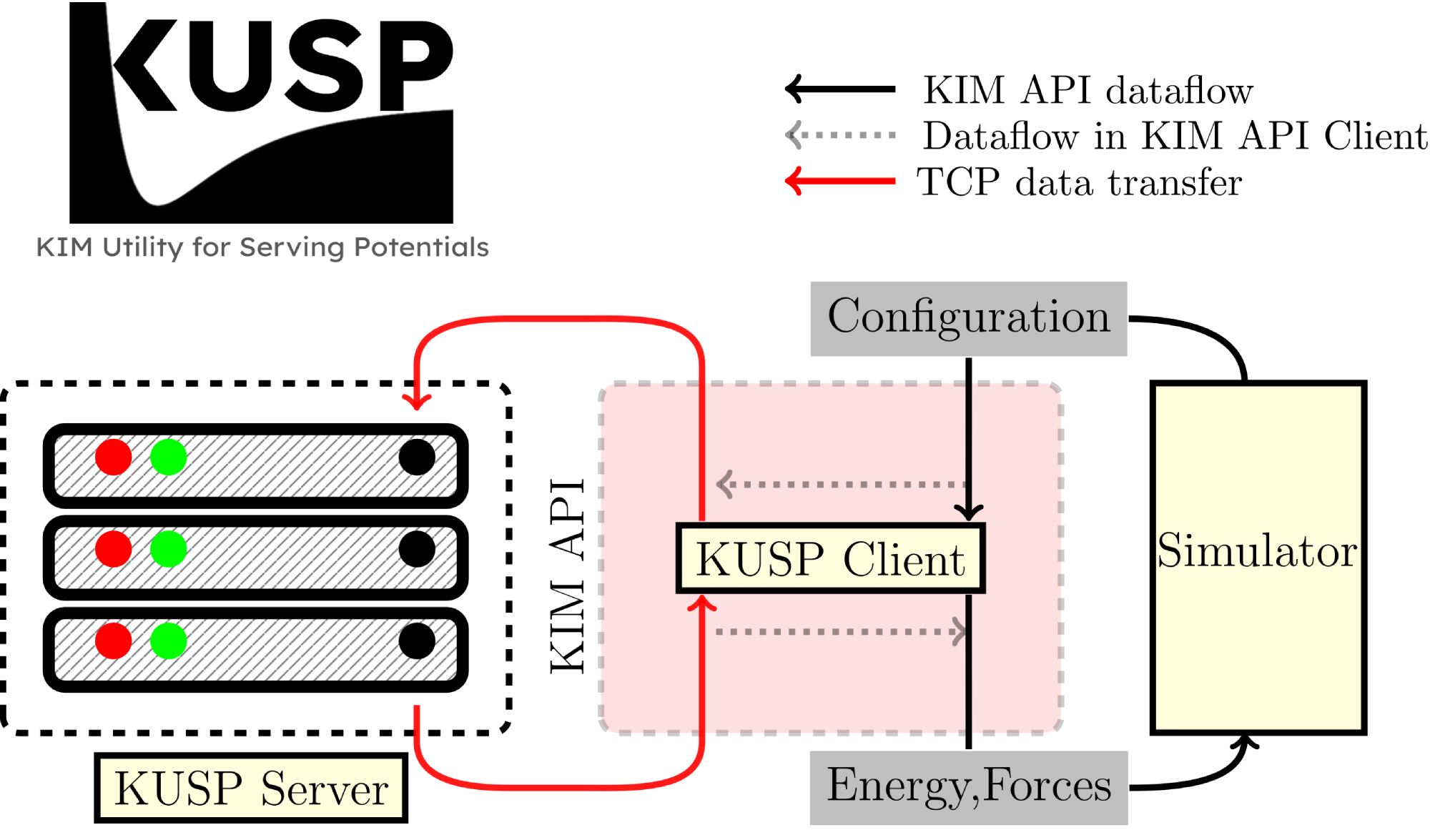
While this is easy and quick, it is not the most efficient way to run ML models. Besides the overhead of Python interpreter, you also have the communication overhead between Python and C++ code, and overhead of the data transfer process, which is usually 100-400ms per call. This is not a problem for very large models, but for small models, this overhead can be significant.
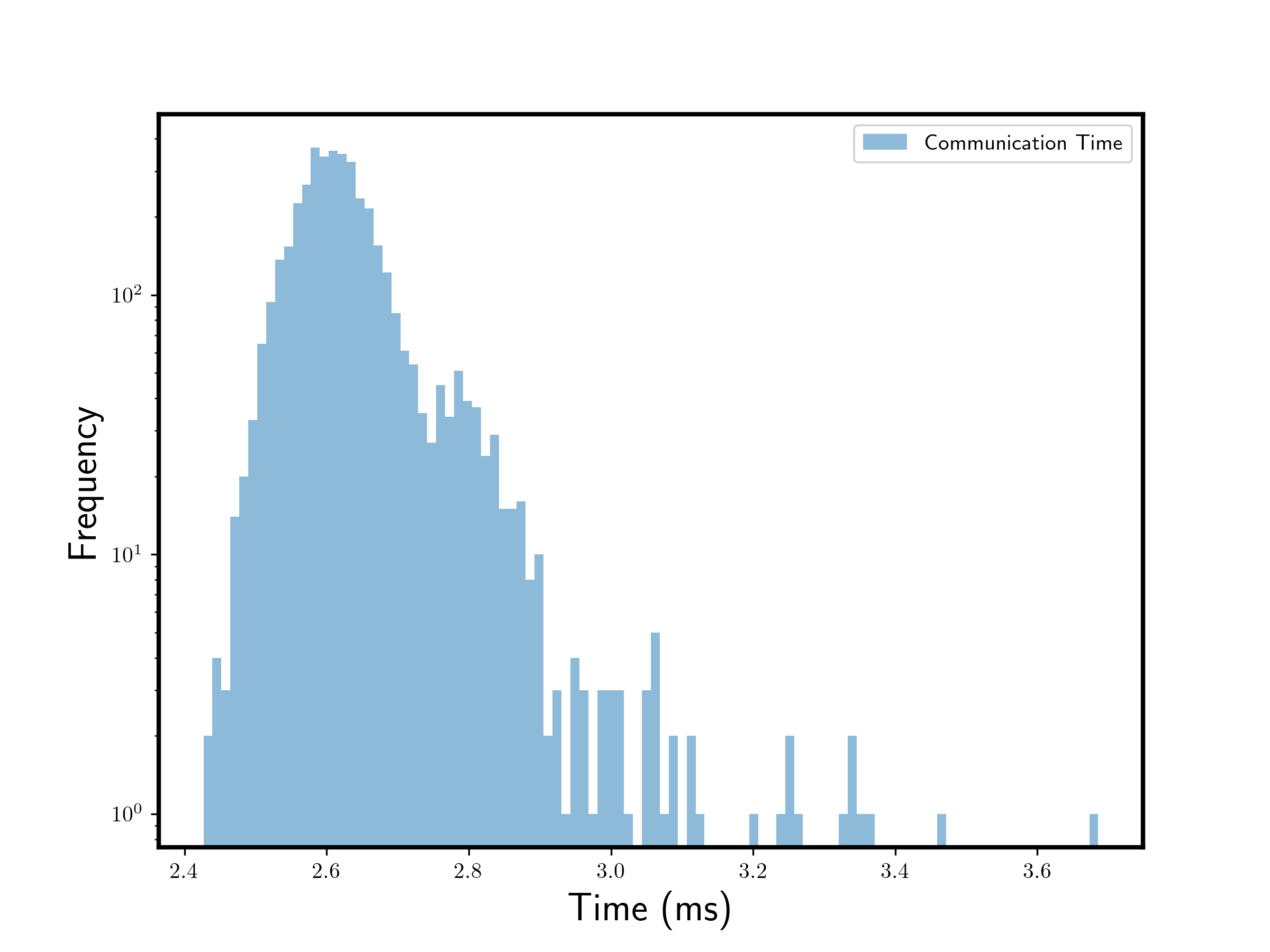
Also, KUSP is not designed to be portable from user to user, while with KIM API
you can install any model as simply as kim-api-collections-management install user <model>.
Hence, while KUSP is good for prototyping, users are encouraged to covert their models
to KIM API compatible models, and use the KIM model drivers for production runs.
KUSP Protocol
KUSP uses a simple protocol to communicate with the KIM API. The protocol expects the configuration information in following order,
    [Necessary] First 4 bytes: size of integer on the system (int_width), 32 bit integer
    [Necessary] Next int_width bytes: number of atoms (n_atoms), default int_width integer
    [Necessary] Next int_width x n_atoms bytes: atomic numbers
    [Necessary] Next 8 x 3 x n_atoms bytes: positions of atoms (x, y, z), double precision
    [Optional] Next int_width x n_atoms bytes: Which atoms to compute energy for (contributing atoms)
Dependencies
KUSP is a minimal dependency package, but it requires KIM API to serve potentials in simulator
agnostic framework. Without KIM API user would need to implement own simulator interface.
To install KIM API, just use the conda package manager,
conda install -c conda-forge kim-api=2.3
Environment Variables
To tell the KUSP KIM API client where to find the KUSP server, you need to set the
environment variable KUSP_SERVER_CONFIG to the path of the configuration file.
export KUSP_SERVER_CONFIG=/path/to/kusp_server_config.yaml
Citation
If you use KUSP in your research, or find it useful, please cite the following paper, accessible here.
@inproceedings{gupta2024kusp,
  title={KUSP: Python server for deploying ML interatomic potentials},
  author={Gupta, Amit and Tadmor, Ellad B and Martiniani, Stefano},
  booktitle={AI for Accelerated Materials Design-Vienna 2024}
}


Download files
Download the file for your platform. If you're not sure which to choose, learn more about installing packages.
Source Distribution
File details
Details for the file kusp-0.1.0.tar.gz.
File metadata
- Download URL: kusp-0.1.0.tar.gz
- Upload date:
- Size: 86.3 kB
- Tags: Source
- Uploaded using Trusted Publishing? No
- Uploaded via: twine/4.0.2 CPython/3.9.15
File hashes
| Algorithm | Hash digest | |
|---|---|---|
| SHA256 |
a6875c1b82aa92ae9f027fbc728c1a2cc94d864e80c1e26bda8e362e2fd773d9
|
|
| MD5 |
00f6a2ca648601fc75dec5148af6f97a
|
|
| BLAKE2b-256 |
ac4744cd60bdee251fb0f3d5d1daac7c543401794958b1b94de4e771d85b76fb
|






