
Memori Python SDK

Project description

Memory from what agents do, not just what they say.
Memori plugs into the software and infrastructure you already use. It is LLM, datastore and framework agnostic and seamlessly integrates into the architecture you've already designed.
→ Memori Cloud — Zero config. Get an API key and start building in minutes.







Choose memory that performs

Getting Started
Installation
TypeScript SDK
npm install @memorilabs/memori
Python SDK
pip install memori
Quickstart
Sign up at app.memorilabs.ai, get a Memori API key, and start building. Full docs: memorilabs.ai/docs/memori-cloud/.
Set MEMORI_API_KEY and your LLM API key (e.g. OPENAI_API_KEY), then:
TypeScript SDK
import { OpenAI } from 'openai';
import { Memori } from '@memorilabs/memori';

// Requires MEMORI_API_KEY and OPENAI_API_KEY in your environment
const client = new OpenAI();
const mem = new Memori().llm
  .register(client)
  .attribution('user_123', 'support_agent');

async function main() {
  await client.chat.completions.create({
    model: 'gpt-4o-mini',
    messages: [{ role: 'user', content: 'My favorite color is blue.' }],
  });
  // Conversations are persisted and recalled automatically in the background.

  const response = await client.chat.completions.create({
    model: 'gpt-4o-mini',
    messages: [{ role: 'user', content: "What's my favorite color?" }],
  });
  // Memori recalls that your favorite color is blue.
}
Python SDK
from memori import Memori
from openai import OpenAI

# Requires MEMORI_API_KEY and OPENAI_API_KEY in your environment
client = OpenAI()
mem = Memori().llm.register(client)

mem.attribution(entity_id="user_123", process_id="support_agent")

response = client.chat.completions.create(
    model="gpt-4o-mini",
    messages=[{"role": "user", "content": "My favorite color is blue."}]
)
# Conversations are persisted and recalled automatically.

response = client.chat.completions.create(
    model="gpt-4o-mini",
    messages=[{"role": "user", "content": "What's my favorite color?"}]
)
# Memori recalls that your favorite color is blue.
Explore the Memories
Use the Dashboard — Memories, Analytics, Playground, and API Keys.
[!TIP] Want to use your own database? Check out docs for Memori BYODB here: https://memorilabs.ai/docs/memori-byodb/.
LoCoMo Benchmark
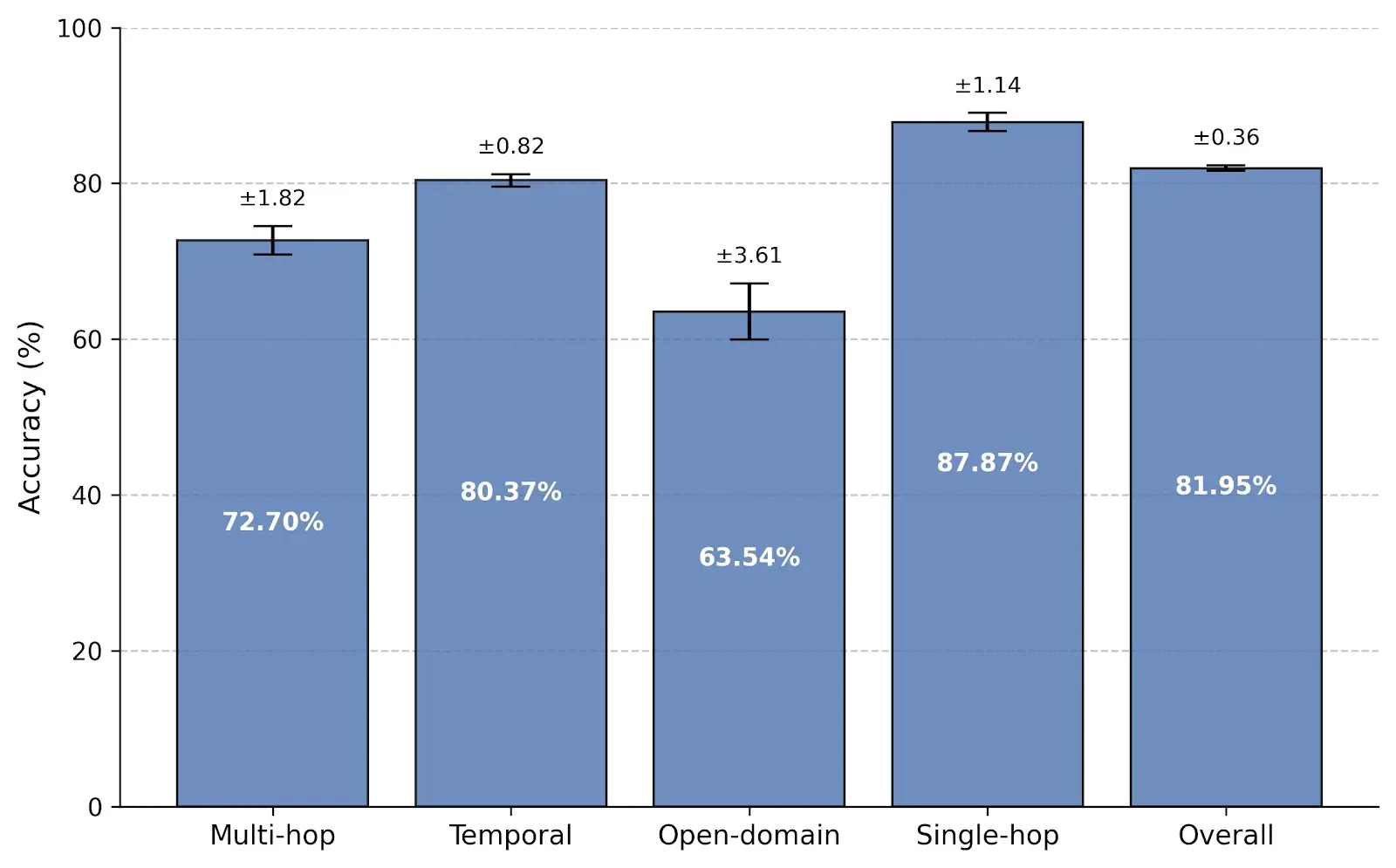
Memori was evaluated on the LoCoMo benchmark for long-conversation memory and achieved 81.95% overall accuracy while using an average of 1,294 tokens per query. That is just 4.97% of the full-context footprint, showing that structured memory can preserve reasoning quality without forcing large prompts into every request.
Compared with other retrieval-based memory systems, Memori outperformed Zep, LangMem, and Mem0 while reducing prompt size by roughly 67% vs. Zep and lowering context cost by more than 20x vs. full-context prompting.
Read the benchmark overview, see the results, or download the paper.
OpenClaw (Persistent Memory for Your Gateway)
By default, OpenClaw agents forget everything between sessions. The Memori plugin fixes that. It captures durable facts and preferences after each conversation, then injects the most relevant context back into future prompts automatically.
No changes to your agent code or prompts are required. The plugin hooks into OpenClaw's lifecycle, so you get structured memory, Intelligent Recall, and Advanced Augmentation with a drop-in plugin.
openclaw plugins install @memorilabs/openclaw-memori
openclaw plugins enable openclaw-memori

openclaw config set plugins.entries.openclaw-memori.config.apiKey "YOUR_MEMORI_API_KEY"
openclaw config set plugins.entries.openclaw-memori.config.entityId "your-app-user-id"

openclaw gateway restart
For setup and configuration, see the OpenClaw Quickstart. For architecture and lifecycle details, see the OpenClaw Overview.
Hermes Agent (Persistent Memory Provider)
Memori also ships as a Hermes Agent memory provider. It captures completed conversations in the background and gives Hermes explicit memori_recall and memori_recall_summary tools for agent-controlled recall.
pip install hermes-memori

hermes config set memory.provider memori
HERMES_HOME="${HERMES_HOME:-$HOME/.hermes}"
mkdir -p "$HERMES_HOME"
echo "MEMORI_API_KEY=YOUR_MEMORI_API_KEY" >> "$HERMES_HOME/.env"
echo "MEMORI_ENTITY_ID=your-app-user-id" >> "$HERMES_HOME/.env"
echo "MEMORI_PROJECT_ID=hermes" >> "$HERMES_HOME/.env"
For setup and configuration, see the Hermes Quickstart. For architecture and lifecycle details, see the Hermes Overview.
MCP (Connect Your Agent in One Command)
Your agent forgets everything between sessions. Memori fixes that. It remembers your stack, your conventions, and how you like things done so you stop repeating yourself.
Works for solo developers and teams. Your agent learns coding patterns, reviewer preferences, and project conventions over time. For teams, that means shared context that new engineers pick up on day one instead of absorbing tribal knowledge over months.
If you use Claude Code, Cursor, Codex, Warp, or Antigravity, you can connect Memori with no SDK integration needed:
claude mcp add --transport http memori https://api.memorilabs.ai/mcp/ \
  --header "X-Memori-API-Key: ${MEMORI_API_KEY}" \
  --header "X-Memori-Entity-Id: your_username" \
  --header "X-Memori-Process-Id: claude-code"
For Cursor, Codex, Warp, and other clients, see the MCP client setup guide.
Attribution
To get the most out of Memori, you want to attribute your LLM interactions to an entity (think person, place or thing; like a user) and a process (think your agent, LLM interaction or program).
If you do not provide any attribution, Memori cannot make memories for you.
TypeScript SDK
mem.attribution("12345", "my-ai-bot");
Python SDK
mem.attribution(entity_id="12345", process_id="my-ai-bot")
Session Management
Memori uses sessions to group your LLM interactions together. For example, if you have an agent that executes multiple steps you want those to be recorded in a single session.
By default, Memori handles setting the session for you but you can start a new session or override the session by executing the following:
TypeScript SDK
mem.resetSession();
// or
mem.setSession(sessionId);
Python SDK
mem.new_session()
# or
mem.set_session(session_id)
Supported LLMs
- Anthropic
- Bedrock
- DeepSeek
- Gemini
- Grok (xAI)
- OpenAI (Chat Completions & Responses API)
(unstreamed, streamed, synchronous and asynchronous)
Supported Frameworks
- Agno
- LangChain
- Pydantic AI
Supported Platforms
- DeepSeek
- Nebius AI Studio
Examples
For more examples and demos, check out the Memori Cookbook.
Memori Advanced Augmentation
Memories are tracked at several different levels:
- entity: think person, place, or thing; like a user
- process: think your agent, LLM interaction or program
- session: the current interactions between the entity, process and the LLM
Memori's Advanced Augmentation enhances memories at each of these levels with:
- attributes
- events
- facts
- people
- preferences
- relationships
- rules
- skills
Memori knows who your user is, what tasks your agent handles and creates unparalleled context between the two. Augmentation occurs in the background incurring no latency.
By default, Memori Advanced Augmentation is available without an account but rate limited. When you need increased limits, sign up for Memori Advanced Augmentation or use the Memori CLI:
# Install the CLI via pip to manage your account
python -m memori sign-up <email_address>
Memori Advanced Augmentation is always free for developers!
Once you've obtained an API key, set the following environment variable (used by both Python and TypeScript SDKs):
export MEMORI_API_KEY=[api_key]
Managing Your Quota
At any time, you can check your quota using the Memori CLI (works for both SDKs):
python -m memori quota
Or by checking your account at https://app.memorilabs.ai/. If you have reached your IP address quota, sign up and get an API key for increased limits.
If your API key exceeds its quota limits we will email you and let you know.
Command Line Interface (CLI)
The Memori CLI is the unified tool for managing your account, keys, and quotas across all SDKs. To use it, execute the following from the command line:
# Requires Python installed
python -m memori
This will display a menu of the available options. For more information about what you can do with the Memori CLI, please reference Command Line Interface.
Contributing
We welcome contributions from the community! Please see our Contributing Guidelines for details on:
- Setting up your development environment
- Code style and standards
- Submitting pull requests
- Reporting issues
Support
License
Apache 2.0 - see LICENSE
Release history Release notifications | RSS feed


Download files
Download the file for your platform. If you're not sure which to choose, learn more about installing packages.
Source Distribution
Built Distributions
Filter files by name, interpreter, ABI, and platform.
If you're not sure about the file name format, learn more about wheel file names.
Copy a direct link to the current filters
File details
Details for the file memori-3.3.3.tar.gz.
File metadata
- Download URL: memori-3.3.3.tar.gz
- Upload date:
- Size: 186.5 kB
- Tags: Source
- Uploaded using Trusted Publishing? No
- Uploaded via: twine/6.1.0 CPython/3.13.12
File hashes
| Algorithm | Hash digest | |
|---|---|---|
| SHA256 |
f9fa07b90581eb0f925a2e1dca5ad21ff8534ed62d0f3e731bb51634014932f0
|
|
| MD5 |
f879d0e46f9d94f846300e0c5d2c01e8
|
|
| BLAKE2b-256 |
bec568995f180c75b50cf6bf65044a7be88bd0e707fecfad9827b749cea26e3e
|
File details
Details for the file memori-3.3.3-cp310-abi3-win_amd64.whl.
File metadata
- Download URL: memori-3.3.3-cp310-abi3-win_amd64.whl
- Upload date:
- Size: 4.8 MB
- Tags: CPython 3.10+, Windows x86-64
- Uploaded using Trusted Publishing? No
- Uploaded via: twine/6.1.0 CPython/3.13.12
File hashes
| Algorithm | Hash digest | |
|---|---|---|
| SHA256 |
4ae5576c0af77f1a0724752a2d7e68307021a9d7b0b5ac56e813755bda766b62
|
|
| MD5 |
297685a56f1848d382cd68344bdc0b34
|
|
| BLAKE2b-256 |
0a18a71fd60d52903abfaa5bacdc5d0c09b050ab3f01783c7651283f746a5ddf
|
File details
Details for the file memori-3.3.3-cp310-abi3-manylinux_2_28_x86_64.whl.
File metadata
- Download URL: memori-3.3.3-cp310-abi3-manylinux_2_28_x86_64.whl
- Upload date:
- Size: 8.0 MB
- Tags: CPython 3.10+, manylinux: glibc 2.28+ x86-64
- Uploaded using Trusted Publishing? No
- Uploaded via: twine/6.1.0 CPython/3.13.12
File hashes
| Algorithm | Hash digest | |
|---|---|---|
| SHA256 |
f6415477dbe2249e39280c129573ef9d691248ddcea0ccdf82bd4e37e7bfef23
|
|
| MD5 |
659c231726fd8d6b59d426d699aa1d4f
|
|
| BLAKE2b-256 |
96fa32ee183c4362df6f9519f0621022779841c5af47d0f7ca97ffa1b2917b59
|
File details
Details for the file memori-3.3.3-cp310-abi3-manylinux_2_28_aarch64.whl.
File metadata
- Download URL: memori-3.3.3-cp310-abi3-manylinux_2_28_aarch64.whl
- Upload date:
- Size: 8.5 MB
- Tags: CPython 3.10+, manylinux: glibc 2.28+ ARM64
- Uploaded using Trusted Publishing? No
- Uploaded via: twine/6.1.0 CPython/3.13.12
File hashes
| Algorithm | Hash digest | |
|---|---|---|
| SHA256 |
553f858fb21706bf300b676ed4762d170e354633cca744b35afa1506393eaece
|
|
| MD5 |
5026b028d6f823a4760920fe86169367
|
|
| BLAKE2b-256 |
2528e76ba13f7c23ada59003b549d8adad75ff8d7262c0abcbcae943c2b30923
|
File details
Details for the file memori-3.3.3-cp310-abi3-macosx_11_0_x86_64.whl.
File metadata
- Download URL: memori-3.3.3-cp310-abi3-macosx_11_0_x86_64.whl
- Upload date:
- Size: 5.4 MB
- Tags: CPython 3.10+, macOS 11.0+ x86-64
- Uploaded using Trusted Publishing? No
- Uploaded via: twine/6.1.0 CPython/3.13.12
File hashes
| Algorithm | Hash digest | |
|---|---|---|
| SHA256 |
7dd9c2e5c1401d5b4c1c40d06bde7016ceb762328810b33d9e838b5107a0f08f
|
|
| MD5 |
dcf2ee84a137fedfbdc4fa2a599e2307
|
|
| BLAKE2b-256 |
c7692313aab31badd73deeefb3d1a32a4a7aa2df1ce0aadaedb6d374e36ff6da
|
File details
Details for the file memori-3.3.3-cp310-abi3-macosx_11_0_arm64.whl.
File metadata
- Download URL: memori-3.3.3-cp310-abi3-macosx_11_0_arm64.whl
- Upload date:
- Size: 5.2 MB
- Tags: CPython 3.10+, macOS 11.0+ ARM64
- Uploaded using Trusted Publishing? No
- Uploaded via: twine/6.1.0 CPython/3.13.12
File hashes
| Algorithm | Hash digest | |
|---|---|---|
| SHA256 |
fb7c753705648ffcbe0aa4d6d6e6c4d8474f97a58482a129fb6099cf0cbe5aff
|
|
| MD5 |
7922e00df4298f426aa930b5ba8aa843
|
|
| BLAKE2b-256 |
d703b6e92b69801042bdcfd9b690c6ae9452590d1e78b9411976bb9167082b4f
|
File details
Details for the file memori-3.3.3-cp310-abi3-android_24_x86_64.whl.
File metadata
- Download URL: memori-3.3.3-cp310-abi3-android_24_x86_64.whl
- Upload date:
- Size: 8.4 MB
- Tags: Android API level 24+ x86-64, CPython 3.10+
- Uploaded using Trusted Publishing? No
- Uploaded via: twine/6.1.0 CPython/3.13.12
File hashes
| Algorithm | Hash digest | |
|---|---|---|
| SHA256 |
e832cd8633f7f766f3e46a86c4518a80f4873e1175c686ff125d4f237124cd51
|
|
| MD5 |
3bfe4f075fbd5f64e0fda33129e0ebdc
|
|
| BLAKE2b-256 |
8ccbbe94089d0d019081aab9910c069f3ea6c79e272628215a5c9d8f6a4febc1
|
File details
Details for the file memori-3.3.3-cp310-abi3-android_24_arm64_v8a.whl.
File metadata
- Download URL: memori-3.3.3-cp310-abi3-android_24_arm64_v8a.whl
- Upload date:
- Size: 8.8 MB
- Tags: Android API level 24+ ARM64 v8a, CPython 3.10+
- Uploaded using Trusted Publishing? No
- Uploaded via: twine/6.1.0 CPython/3.13.12
File hashes
| Algorithm | Hash digest | |
|---|---|---|
| SHA256 |
14deb22803f54014a21ae5e2b7e978be48783e9593c1fb7b8934f2c6c22967c8
|
|
| MD5 |
7269792902cab21897f38bd467ed2315
|
|
| BLAKE2b-256 |
7d626102abc7da39b555bab4936f9263be57cfb00ac86d7bd3e39cd4729fdfa6
|






