
Redis Streams client implementation for high availability usage including consumer, monitor and scaler implementation

Project description
Redis-Streams
This package builds on Redis Streams and provides an easy to use interface for batch collection and processing. Simplifies the consumer group and consumers management. Designed for a highly available, scalable and distributed environment, it thus offers, in addition to the main functionality, monitoring and scaling capabilities.
The main idea is that Redis Streams supports several message producers. The messages then organized into consumer groups where multiple consumers can collect a batch of items, process them and acknowledge the successfully processed ones. If processing fails, the message has not been acknowledged will be part of the next batch. In case of consumer failure the monitor component will re-assign the related messages to a healthy consumer this way messages don't get lost. Optional scaling component monitors incoming/processed message rate and suggests consumer scale if necessary
Installation
Latest version:
pip3 install redis-streams
Components
Overview of the components
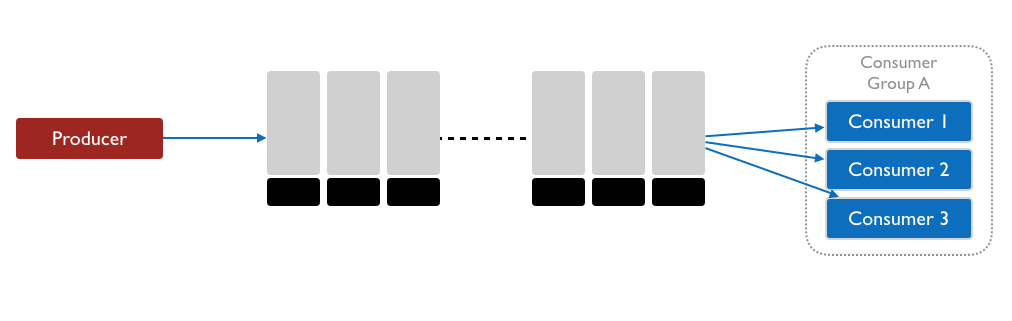
Producer
As its name suggests, this component is responsible for providing the messages in the stream. Redis supports multiple producers.
Example code
from redis import Redis
from redis_streams.producer import Producer

redis_conn = Redis()
producer = Producer(redis_conn=redis_conn, stream=STREAM)

# publish a single message
msg_id = producer.add({"message": "stuff goes here"})
print(f"Published {msg_id}")

# optional: cap the stream length with approximate trimming
producer_with_trim = Producer(redis_conn=redis_conn, stream=STREAM, maxlen=10000)
producer_with_trim.add({"message": "older entries will be trimmed"})
Consumer
The consumer registers in the consumer group and start fetching for available messages. Once a preconfigured batch size is reached, it gives back the list of items to the caller which then can acknowledge this way remove from the Stream the message. The consumer implementation returns after the preconfigured maximum weight time, even if the lot is not full. This way the items won't wait long in the stream
Example code
# It is crucial to enable "decode_response" feature of Redis
redis_conn = Redis(decode_responses=True)
consumer = Consumer(
        redis_conn=redis_conn,
        stream=STREAM,
        consumer_group=GROUP,
        batch_size=10,
        max_wait_time_ms=30000
    )
while True:
    messages = consumer.get_items()
    total_no_of_messages = len(messages)
    for i, item in enumerate(messages):
        print(f"Pocessing {i}/{total_no_of_messages} message:{item}")
        process_message(item=item)
        consumer.remove_item_from_consumer_group(item_id=item.msgid)
Monitor
Periodically check the activity of the consumers warns if they are idle - not fetching message from the Stream for longer than the preconfigured inactivity threshold or have more assigned messages than the batch size. Automatic or on-demand cleanup are also supported.
Example code
monitor = Monitor(
    redis_conn=Redis(),
    stream=STREAM,
    consumer_group=GROUP,
    batch_size=10,   # batch size has to be tha same as for consumers
)
monitor.collect_monitoring_data(auto_cleanup=True)
monitor.print_monitoring_data()
Output
+-------------------------+-------------+-----------------+----------------------------------+
|             Consumer id |   Idle time |   Pending items | Status                           |
+=========================+=============+=================+==================================+
| b'29102140026848155456' |         923 |               7 | OK                               |
+-------------------------+-------------+-----------------+----------------------------------+
| b'29104139791624517440' |      294191 |               5 | WARNING - idle for long time     |
+-------------------------+-------------+-----------------+----------------------------------+
| b'29144140168467982144' |      361502 |               8 | WARNING - idle for long time     |
+-------------------------+-------------+-----------------+----------------------------------+
| b'29304140033034540864' |        8658 |              11 | WARNING - too many pending items |
+-------------------------+-------------+-----------------+----------------------------------+
| b'29312139940580673344' |       11734 |              58 | WARNING - too many pending items |
+-------------------------+-------------+-----------------+----------------------------------+
| b'29314139867734665024' |       14216 |               1 | OK                               |
+-------------------------+-------------+-----------------+----------------------------------+
Scaler
By checking the number of messages waiting to be assigned and the number of pending items, utilization ratio can be calculated. Once this rate crosses a lower (scale in) or higher (scale out) the code will give a suggestion of scale in / out.
Example code
scaler = Scaler(
    redis_conn=Redis(decode_responses=True),
    stream=STREAM,
    consumer_group=GROUP
)
scaler.collect_metrics()
rate, suggestion = scaler.get_scale_decision(
    scale_out_rate=60, scale_in_rate=20
)
print(
    f"Consumers should be {suggestion} as stream length "
    f"({scaler.stream_lenght}) / pending ({scaler.stream_pending}) "
    f"rate is {rate}%"
)
Output
Consumers should be IN as stream length (11) / pending (83) rate is 13.253%
Consumers should be NO_SCALE as stream length (18) / pending (79) rate is 22.7848%
License
This project is licensed under the terms of the GPL3.0.
Release history Release notifications | RSS feed


Download files
Download the file for your platform. If you're not sure which to choose, learn more about installing packages.
Source Distribution
Built Distribution
Filter files by name, interpreter, ABI, and platform.
If you're not sure about the file name format, learn more about wheel file names.
Copy a direct link to the current filters
File details
Details for the file redis_streams-0.3.0.tar.gz.
File metadata
- Download URL: redis_streams-0.3.0.tar.gz
- Upload date:
- Size: 25.6 kB
- Tags: Source
- Uploaded using Trusted Publishing? No
- Uploaded via: twine/6.2.0 CPython/3.12.3
File hashes
| Algorithm | Hash digest | |
|---|---|---|
| SHA256 |
42f373fbe504859b3a6a846c0be45a15f227536cd3646ecedeaece891a4135e3
|
|
| MD5 |
bde3f35a4abe257ffe74ded35169bd44
|
|
| BLAKE2b-256 |
ee2697d16056a1db0a41c46d9c08fa6d73bd32daceac4171f9f5472668bd7f79
|
File details
Details for the file redis_streams-0.3.0-py3-none-any.whl.
File metadata
- Download URL: redis_streams-0.3.0-py3-none-any.whl
- Upload date:
- Size: 24.9 kB
- Tags: Python 3
- Uploaded using Trusted Publishing? No
- Uploaded via: twine/6.2.0 CPython/3.12.3
File hashes
| Algorithm | Hash digest | |
|---|---|---|
| SHA256 |
04b4e110e6438a37f32dbd9e53cbcbeec76e30853070587a3c7daa1c812b73c4
|
|
| MD5 |
aa720edf06e21f158967c8ee4ac86c13
|
|
| BLAKE2b-256 |
07afb051fd038130229d9653f49cf1a9b52ef261d32f4165a981d948422613f5
|






