
Web apps in pure Python.
Project description


✨ Performant, customizable web apps in pure Python. Deploy in seconds. ✨





English | 简体中文 | 繁體中文 | Türkçe | हिंदी | Português (Brasil) | Italiano | Español | 한국어 | 日本語 | Deutsch | Persian (پارسی) | Tiếng Việt
Reflex
Reflex is a library to build full-stack web apps in pure Python.
Key features:
- Pure Python - Write your app's frontend and backend all in Python, no need to learn Javascript.
- Full Flexibility - Reflex is easy to get started with, but can also scale to complex apps.
- Deploy Instantly - After building, deploy your app with a single command or host it on your own server.
See our architecture page to learn how Reflex works under the hood.
⚙️ Installation
Open a terminal and run (Requires Python 3.10+):
pip install reflex
🥳 Create your first app
Installing reflex also installs the reflex command line tool.
Test that the install was successful by creating a new project. (Replace my_app_name with your project name):
mkdir my_app_name
cd my_app_name
reflex init
This command initializes a template app in your new directory.
You can run this app in development mode:
reflex run
You should see your app running at http://localhost:3000.
Now you can modify the source code in my_app_name/my_app_name.py. Reflex has fast refreshes so you can see your changes instantly when you save your code.
🫧 Example App
Let's go over an example: creating an image generation UI around DALL·E. For simplicity, we just call the OpenAI API, but you could replace this with an ML model run locally.
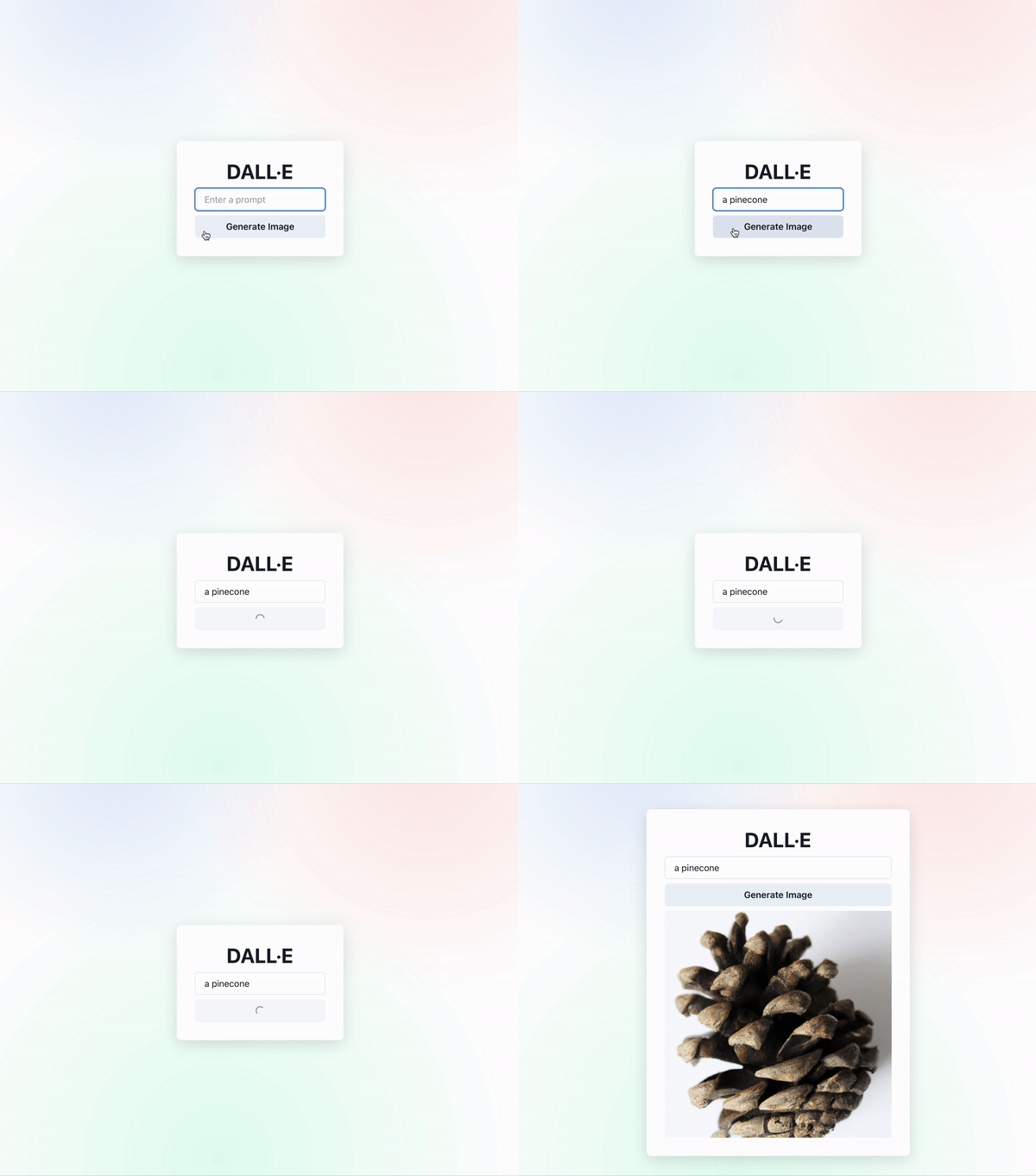
Here is the complete code to create this. This is all done in one Python file!
import reflex as rx
import openai

openai_client = openai.OpenAI()


class State(rx.State):
    """The app state."""

    prompt = ""
    image_url = ""
    processing = False
    complete = False

    def get_image(self):
        """Get the image from the prompt."""
        if self.prompt == "":
            return rx.window_alert("Prompt Empty")

        self.processing, self.complete = True, False
        yield
        response = openai_client.images.generate(
            prompt=self.prompt, n=1, size="1024x1024"
        )
        self.image_url = response.data[0].url
        self.processing, self.complete = False, True


def index():
    return rx.center(
        rx.vstack(
            rx.heading("DALL-E", font_size="1.5em"),
            rx.input(
                placeholder="Enter a prompt..",
                on_blur=State.set_prompt,
                width="25em",
            ),
            rx.button(
                "Generate Image",
                on_click=State.get_image,
                width="25em",
                loading=State.processing
            ),
            rx.cond(
                State.complete,
                rx.image(src=State.image_url, width="20em"),
            ),
            align="center",
        ),
        width="100%",
        height="100vh",
    )

# Add state and page to the app.
app = rx.App()
app.add_page(index, title="Reflex:DALL-E")
Let's break this down.

Reflex UI
Let's start with the UI.
def index():
    return rx.center(
        ...
    )
This index function defines the frontend of the app.
We use different components such as center, vstack, input, and button to build the frontend. Components can be nested within each other
to create complex layouts. And you can use keyword args to style them with the full power of CSS.
Reflex comes with 60+ built-in components to help you get started. We are actively adding more components, and it's easy to create your own components.
State
Reflex represents your UI as a function of your state.
class State(rx.State):
    """The app state."""
    prompt = ""
    image_url = ""
    processing = False
    complete = False
The state defines all the variables (called vars) in an app that can change and the functions that change them.
Here the state is comprised of a prompt and image_url. There are also the booleans processing and complete to indicate when to disable the button (during image generation) and when to show the resulting image.
Event Handlers
def get_image(self):
    """Get the image from the prompt."""
    if self.prompt == "":
        return rx.window_alert("Prompt Empty")

    self.processing, self.complete = True, False
    yield
    response = openai_client.images.generate(
        prompt=self.prompt, n=1, size="1024x1024"
    )
    self.image_url = response.data[0].url
    self.processing, self.complete = False, True
Within the state, we define functions called event handlers that change the state vars. Event handlers are the way that we can modify the state in Reflex. They can be called in response to user actions, such as clicking a button or typing in a text box. These actions are called events.
Our DALL·E. app has an event handler, get_image to which get this image from the OpenAI API. Using yield in the middle of an event handler will cause the UI to update. Otherwise the UI will update at the end of the event handler.
Routing
Finally, we define our app.
app = rx.App()
We add a page from the root of the app to the index component. We also add a title that will show up in the page preview/browser tab.
app.add_page(index, title="DALL-E")
You can create a multi-page app by adding more pages.
📑 Resources
📑 Docs | 🗞️ Blog | 📱 Component Library | 🖼️ Templates | 🛸 Deployment
✅ Status
Reflex launched in December 2022 with the name Pynecone.
Beginning in 2025, Reflex Cloud has launched to provide the best hosting experience for Reflex apps. We will continue to develop it and implement more features.
Reflex has new releases and features coming every other week! Make sure to :star: star and :eyes: watch this repository to stay up to date.
Contributing
We welcome contributions of any size! Below are some good ways to get started in the Reflex community.
- Join Our Discord: Our Discord is the best place to get help on your Reflex project and to discuss how you can contribute.
- GitHub Discussions: A great way to talk about features you want added or things that are confusing/need clarification.
- GitHub Issues: Issues are an excellent way to report bugs. Additionally, you can try and solve an existing issue and submit a PR.
We are actively looking for contributors, no matter your skill level or experience. To contribute check out CONTRIBUTING.md
All Thanks To Our Contributors:
License
Reflex is open-source and licensed under the Apache License 2.0.
Project details
Release history Release notifications | RSS feed


Download files
Download the file for your platform. If you're not sure which to choose, learn more about installing packages.
Source Distribution
Built Distribution
Filter files by name, interpreter, ABI, and platform.
If you're not sure about the file name format, learn more about wheel file names.
Copy a direct link to the current filters
File details
Details for the file reflex-0.7.9a1.tar.gz.
File metadata
- Download URL: reflex-0.7.9a1.tar.gz
- Upload date:
- Size: 560.5 kB
- Tags: Source
- Uploaded using Trusted Publishing? No
- Uploaded via: uv/0.6.16
File hashes
| Algorithm | Hash digest | |
|---|---|---|
| SHA256 |
4e9bfc9c559d04ca1b3507576b10919cec44c95dfc054c7bab7b245e0f6159a7
|
|
| MD5 |
e021126609713efadf9f63a9bd126b84
|
|
| BLAKE2b-256 |
3640a4328a79a36581c082d83b6138efbd67ed8dd9e94059249cd369cf6b5530
|
File details
Details for the file reflex-0.7.9a1-py3-none-any.whl.
File metadata
- Download URL: reflex-0.7.9a1-py3-none-any.whl
- Upload date:
- Size: 849.2 kB
- Tags: Python 3
- Uploaded using Trusted Publishing? No
- Uploaded via: uv/0.6.16
File hashes
| Algorithm | Hash digest | |
|---|---|---|
| SHA256 |
37f18fe3c79b08f83662d7198b2159d55927000a3612dd7fa95683e1c84f0b7f
|
|
| MD5 |
fe0fc8d1bac663131a37e103798eba2b
|
|
| BLAKE2b-256 |
7a83594b0c54f298fc423da22a501ee83e0c022a04aa4f4ce62a6b6ecec64052
|






